

Understanding Google’s Intent-Based Search / Google Top Rated Search (2026)
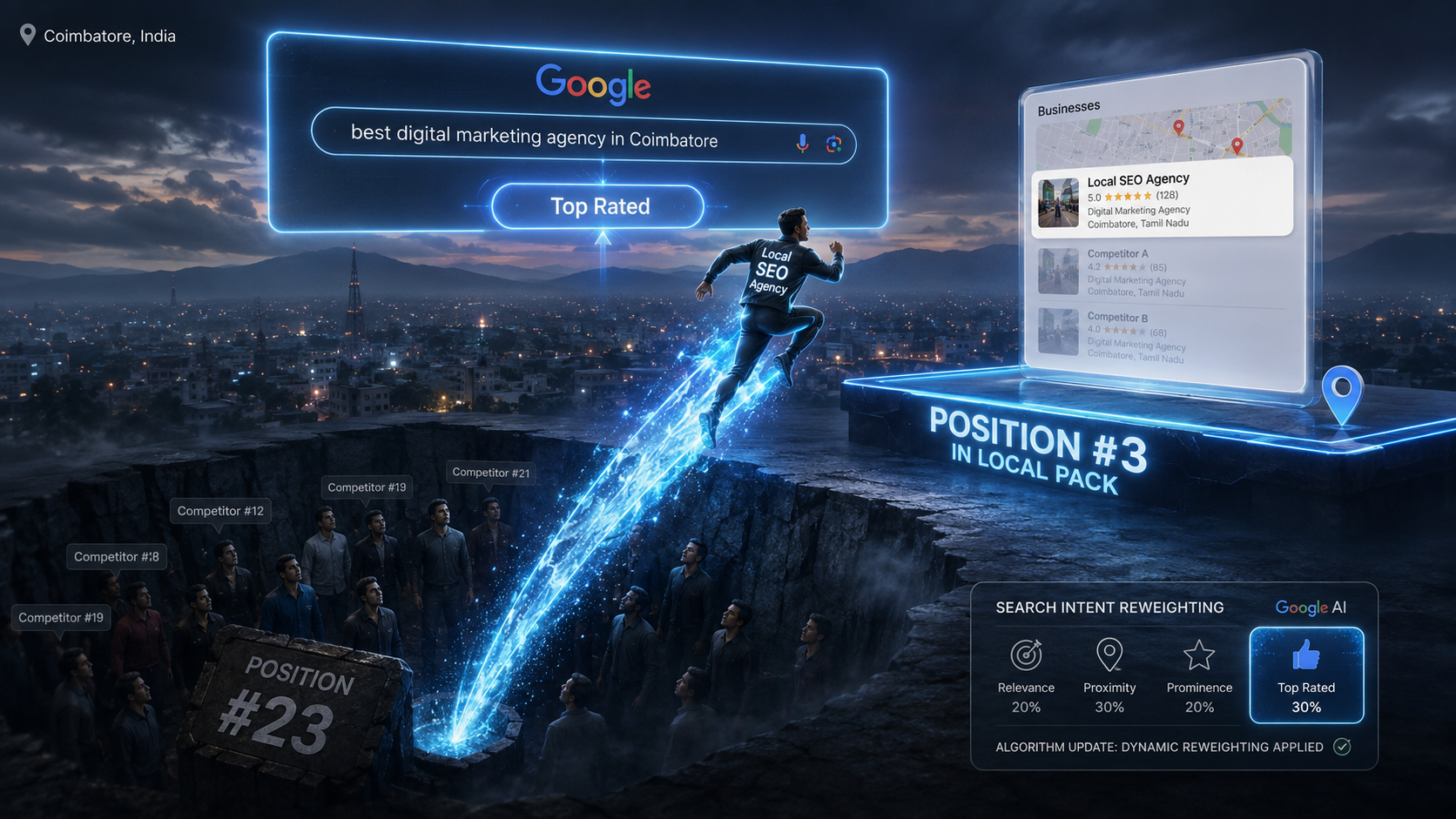
Imagine spending six months on a disciplined local SEO campaign, clean citations, faster pages, location landing pages, valuable editorial links, only to find your target keyword, “Website Development Company in Coimbatore,” sitting at position #23 on page three.
Panic sets in. You check Google Search Console: no manual actions, no crawl errors.
Then you tweak the query to “Best Website Development Company in Coimbatore,” or tap the small, pill-shaped “Top Rated” refinement chip below Google’s search bar. Instantly, the SERP rewrites itself. Your business leaps from #23 straight into position #3 in the Local Map Pack and top-tier organic results.
What just happened? You are observing Google Top Rated Search in real-time, Intent-Based Search Reweighting in action. Google did not penalize your business on the generic query; the user simply triggered a dynamic intent shift from broad discovery to explicit recommendation.
Featured Snippet Definition Box
Google Search Refinement Chips are dynamic UI elements that let users instantly modify query intent mid-session. Toggling chips like “Top Rated” triggers real-time query expansion, shifting focus toward high-relevance, sentiment-verified entity nodes.
Decoder: What Is the Google Top Rated Search Refinement Filter?
Search refinement chips prompt Google to re-evaluate a query using deep learning language models. Clicking “Top Rated” rewrites the request from [service + location] to [top customer sentiment + verified entity prominence + high threshold rating + service + location]. Low-rated listings drop out, and ranking weights transform instantaneously.
Generic Commercial Intent vs. Recommendation Intent
Understanding why rankings swing requires contrasting what Google prioritizes during a generic commercial query versus a Google Top Rated Search query.
| Ranking Factor | Standard Local Query (Broad Intent) | Top Rated Refined Query (Recommendation Intent) |
| Primary Intent | Discovery / Navigational / Proximity | Commercial Evaluation / High Trust / Recommendation |
| Proximity Weighting | Extremely High | Moderate to Low (Prominence overrides distance) |
| Review Rating Threshold | Low (Surfaces 2.5–5.0 star entities if nearby) | Strict (Filters out profiles under ~4.0 stars) |
| Sentiment Analysis Weight | Low / General matching | Extremely High (NLP parses review body text) |
| Backlink & On-Page Weight | High (Traditional domain authority) | Balanced with verified GBP signals |
| Primary SERP Feature | Standard Map Pack + Local Organic | Filtered Map Finder + AI Overview Recommendations |
Guide to Local Map Pack Optimization
The Search Intent Spectrum in Modern AI Search
By 2026, Google’s algorithm no longer treats queries as flat keyword strings. Instead, search requests pass through six intent layers:
- Informational Intent → “What is web development?”
- Navigational Intent → “PixelCrafters Coimbatore website”
- Commercial Investigation → “Website development companies in Coimbatore”
- Transactional Intent → “Hire web developer in Coimbatore price”
- Recommendation Intent → “Best top rated web developer in Coimbatore”
- Hyper-Local Intent → “Web developer near me open now”
AI Mode, Neural Matching & Dynamic Query Expansion

Google relies on three foundational systems: Neural Matching, Entity Understanding, and AI Mode Dynamic Query Expansion.
Neural Matching & Semantic Translation: Neural Matching translates raw query words into underlying concepts. Selecting “Top Rated” tells the algorithm, trained on millions of search sessions, that the user wants the most trusted entity, not simply the closest business.
Entity Understanding & The Knowledge Graph: Google stores businesses as Nodes connected by Edges (relationships, attributes, reviews, geographic boundaries) in its Knowledge Graph.
Real-Time Realignment vs. Static Indexing: Older architectures cached rankings in static tables. Today, Contextual Rendering dynamically pulls candidate entities from the Knowledge Graph and scores them in milliseconds.
Why Sites Rank Higher for “Best” & “Top Rated” Than Generic Terms

It appears paradoxical: why would a site rank #23 for a broad term but leap to #3 when “best” or “Top Rated” is applied? Five trust mechanisms activate under recommendation intent:
- NLP Sentiment Analysis , Google analyzes review text, not just star averages. Phrases like “delivered on time” become ranking fuel once “Top Rated” activates.
- Unlinked Brand Mentions & Digital Citations , Mentions in local blogs or directories alongside “top developers” count as trust votes, even without hyperlinks.
- GBP Entity Verification , A fully verified, correctly categorized profile with complete service menus signals legitimacy. Neglected profiles drop out under high-trust filters.
- Review Velocity, Diversity & Response Rate , 200 static reviews from three years ago often lose to 85 reviews arriving steadily, with detailed commentary and owner responses.
- On-Page First-Hand E-E-A-T Signals , Case studies, team profiles, and original portfolios confirm real-world capability matches the review footprint.
Click on to know Google Search Central Documentation on E-E-A-T and Helpful Content Guidelines
Is This a Core Algorithm Update or an Interface Evolution?

It is essential to separate algorithmic penalties from contextual interface rendering. If your agency sits at #23 for “Web Development” but jumps to #3 when “Top Rated” is clicked, your site is not penalized, it simply lacks the raw proximity or backlink volume to win the default physical search, while possessing the sentiment trust and entity authority to win the recommendation search.
Step-by-Step Optimization Guide for Intent-Based Search
To capture traffic across both standard commercial searches and refined Google Top Rated Search queries, build an integrated strategy addressing physical relevance and recommendation trust simultaneously.
Step 1: Establish Local & Topical Entity Authority , Define primary and secondary GBP categories matching your core offering, and keep NAP (Name, Address, Phone) data consistent across directories to prevent entity ambiguity.
Step 2: Build Recommendation-Worthy Content & Review Pipelines , Automate review acquisition, encourage keyword-rich reviews naming specific services delivered, and respond to reviews within 24–48 hours.
Step 3: Structure Semantic Content Clusters & Schema Markup , Build dedicated service-location pages instead of one global services page, and deploy LocalBusiness, ProfessionalService, AggregateRating, and Service JSON-LD schema.
Step 4: Optimize for On-Page E-E-A-T , Feature verified case studies with metrics and testimonials, and showcase real team members, certifications, and physical office locations.
Quick Win: 3-Step GBP Optimization
- Audit your primary category for alignment with high-converting intent.
- Seed keyword-rich service menus matching NLP intent queries.
- Add subtle review-page prompts encouraging clients to detail what was built and where.
The Future of Intent Search

Generative Engine Optimization (GEO) & Answer Engine Optimization (AEO): Search engines are shifting from list providers to answer engines, with future SERPs building personalized recommendations inside AI Overviews. GEO keeps your brand referenced across the trusted sources that train these models.
Search Experience Optimization (SXO): SXO combines classic SEO with conversion optimization and UX design. Google increasingly tracks behavioral signals, dwell time, interaction rates, direct brand searches, to confirm recommended sites deliver strong post-click experiences.
Deep Entity-Driven Search: The line between “webpage optimization” and “entity optimization” keeps widening, as Google grades businesses on their entire digital footprint, reviews, social validation, press coverage, and structured schema.
Frequently Asked Questions (FAQ)
Q1: Why do rankings change when I toggle the “Top Rated” filter? A: It shifts Google’s weighting from physical proximity to high-prominence entity validation, filtering out lower-rated entities and re-ranking on sentiment, ratings, and E-E-A-T signals.
Q2: What minimum star rating is required to appear under “Top Rated”? A: Google publishes no static cutoff, but data suggests 4.0 to 4.5 stars plus sufficient recent review volume relative to the local baseline.
Q3: Does my website content impact my Google Top Rated Search ranking? A: Yes. Schema markup, dedicated service pages, case studies, and E-E-A-T trust factors reinforce your Google Business Profile entity data.
Q4: How often does Google recalculate “Top Rated” rankings? A: Candidate sets are evaluated dynamically, in real-time, the moment a query is entered or a refinement chip is toggled.
Q5: Do third-party review sites (like Yelp or Clutch) influence the “Top Rated” chip? A: Yes. Google indexes third-party aggregators and digital citations to confirm entity prominence and cross-validate sentiment.
Q6: Does toggling “Top Rated” change organic results or just the Map Pack? A: Both. It re-ranks the Local Map Pack and alters traditional organic listings and AI Overviews.
Q7: How does GEO factor into “Top Rated” search? A: GEO ensures your business entity is clearly defined with structured data and consistent sentiment so AI engines naturally select your brand in recommendations.
Final thoughts
Search ranking fluctuations are not arbitrary, they are the natural outcome of a sophisticated, intent-driven engine matching user requests with precise recommendations via Google Top Rated Search. Winning in 2026 and beyond requires moving past basic keyword tracking toward a robust, sentiment-rich entity presence.
For Technical SEO Audit & Local Growth Consultation Services, click here.
Ready to Dominate Both Generic & Recommendation Search?
Whether you run a local enterprise in Coimbatore or a multi-location brand nationally, navigating AI Mode, dynamic search refinements, and entity SEO requires technical precision.
Contact our Senior SEO Engineering Team for a comprehensive technical SEO audit and local entity teardown. Let’s turn intent fluctuations into your highest-converting growth channel.
Visit Xplore Intellects and start Exploring!