


Rankings can shift dramatically even when a website stays exactly the same. Over the past few months, Google has rolled out two confirmed core updates, one in March 2026 and another in May 2026, reshuffling search results for thousands of websites across Tamil Nadu and the rest of India.
This guide breaks down what the latest Google algorithm update actually involves, why Google updates today look different from a few years ago, and what business owners across India should do next, without panicking over one bad week or chasing every algorithm headline.
What Are Google Algorithms?
A Google algorithm is the set of rules and systems Google’s software uses to decide which web A Google algorithm is the set of rules and systems Google’s software uses to decide which web pages deserve to appear, and in what order, for a given search query.
Google crawls the web to discover pages, indexes the useful ones, and then ranks them using hundreds of signals the moment someone searches. The way people search has shifted from short typed keywords to full conversational questions asked of AI Mode and AI Overviews.
Algorithm vs. ranking factors:The algorithm is the overall decision engine. Ranking factors are the individual ingredients it weighs, like page speed, content depth, or backlinks. Most updates change how heavily these ingredients are weighed rather than introducing an entirely new rule.
What Is the Latest Google Algorithm Update (2026)?
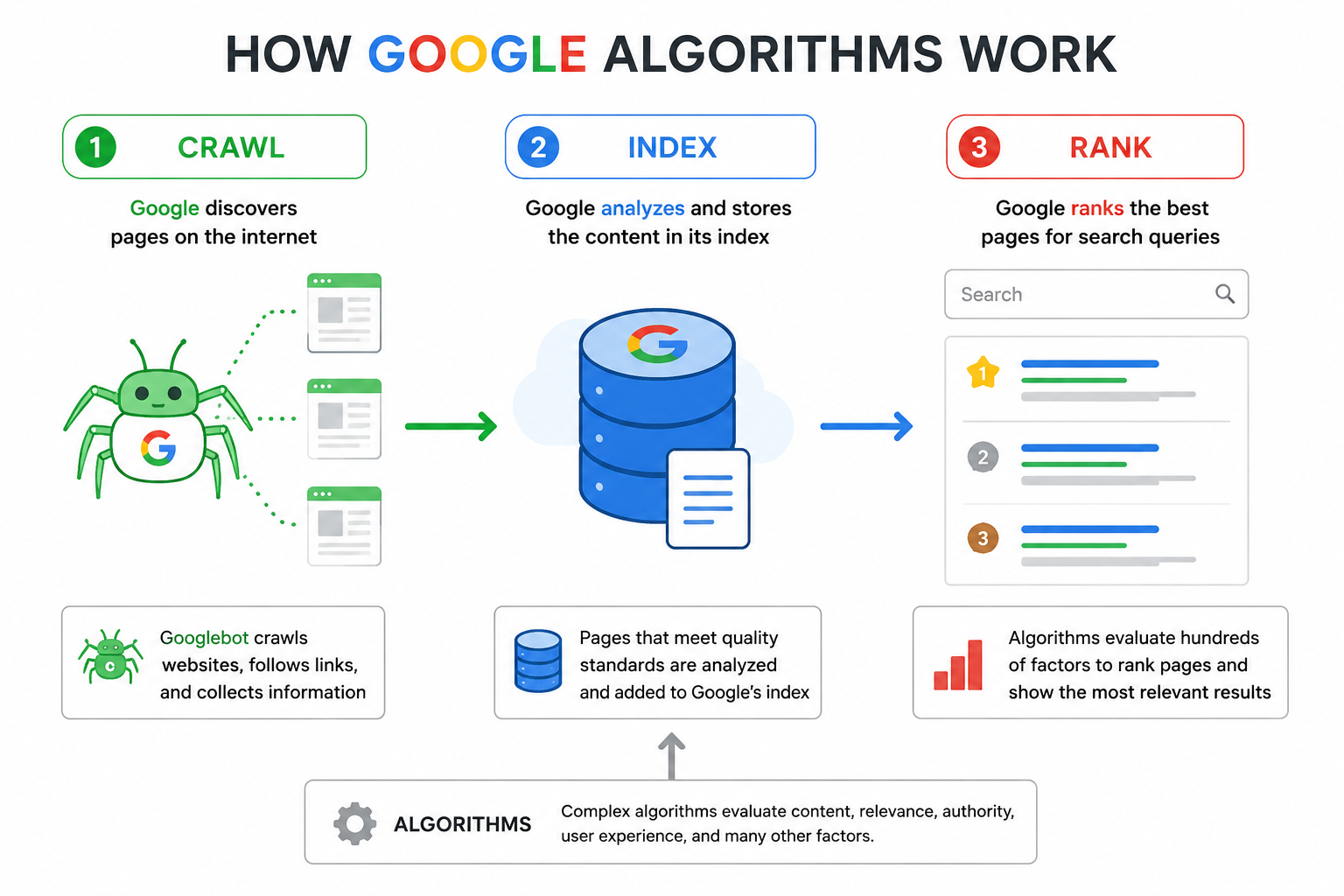
Google does not publish a fixed, public calendar of updates, but 2026 has already delivered two confirmed broad core updates.
- First update: rolled out in late March 2026
- Second update: the May 2026 core update, began the third week of May and finished in early June
What has really changed is less about any single named update and more about the direction Google’s evaluation has taken. Search systems today do more comparative judging, measuring a page against every other page competing for the same query, rather than checking it against a static checklist.
Three things deserve a business owner’s attention:
- Whether the content genuinely outperforms competing pages for the searcher’s real intent
- Whether the technical foundation of speed, mobile experience, and crawlability is solid enough to be considered at all
- Whether the site demonstrates credible expertise and first-hand experience rather than generic, recycled information
Why Google Algorithm Updates Matter
A two-position drop in rankings can look minor on a spreadsheet, but it rarely stays minor in a business’s results. Lower rankings mean fewer impressions, fewer impressions mean fewer clicks, and fewer clicks eventually mean fewer inquiries reaching a sales team.
The trust factor:Customers increasingly treat a strong Google presence, visible reviews, a well-ranked website, a confident answer inside an AI Overview, as a signal of legitimacy. When visibility drops, it isn’t only traffic that suffers, it’s the perception that a brand is established and trustworthy..
Common Types of Google Updates
Not every Google update behaves the same way, and knowing the difference helps a business respond correctly instead of overreacting to normal fluctuation.
| Update Type | What It Targets | Business Impact |
| Core Updates | Overall content quality, relevance, and helpfulness across the entire site | Can shift rankings broadly, even on pages that were never “wrong,” simply outranked |
| Helpful Content Updates | Content written mainly to rank rather than to genuinely help readers | Thin or AI-assembled pages with no real expertise lose visibility first |
| Spam Updates | Manipulative tactics such as cloaking, link schemes, and auto-generated spam | Sites using these tactics can see sharp, fast drops, sometimes within hours |
| Reviews Updates | Quality and originality of product and service review content | Generic, unoriginal reviews lose ground to first-hand, tested ones |
| Page Experience | Site speed, mobile usability, safe browsing, and intrusive interstitials | Slow or clunky sites lose a ranking edge even with strong content |
| AI Search Improvements | How AI Overviews and AI Mode select, summarize, and cite sources | Determines whether a business gets quoted inside AI-generated answers |
Signs Your Website Was Affected
A genuine algorithm impact usually shows a pattern rather than a single bad day. Watch for the following:
- Sustained ranking drops across multiple keywords, not just one
- A noticeable organic traffic decline over one to two weeks
- Falling impressions in Search Console even with a stable click-through rate
- Fewer calls or form submissions specifically from organic search
- Loss of a featured snippet a page previously held
- Reduced visibility inside Google’s AI Overviews for familiar queries
How Google Evaluates Websites Today
Modern ranking decisions lean heavily on the Helpful Content System and the broader EEAT framework:
- Experience
- Expertise
- Authoritativeness
- Trust
Google is trying to reward pages written by people who have actually done the thing they are writing about, not pages assembled purely to satisfy a keyword list.
A connected detail:Even browser-level changes can ripple into rankings indirectly. Because Core Web Vitals are measured using real Chrome user data, a new Chrome update can occasionally shift how page experience scores are calculated.
Common SEO Mistakes That Trigger Ranking Drops
Several patterns show up again and again in sites that lose visibility after an update.
- Keyword stuffing, even when dressed up as “natural” repetition
- Thin content that merely rewords a competitor’s page without adding anything new
- Poor user experience: slow load times, intrusive pop-ups, confusing navigation
- Duplicate or near-duplicate pages competing for the same keyword
- Weak internal linking that leaves valuable pages isolated and hard to discover
- Ignoring technical SEO basics like broken links, missing schema, or slow mobile rendering
- Outdated content that hasn’t been revisited in years
- Large volumes of unedited AI-generated content with no real expertise or original insight
How Businesses Should Respond: A Practical Checklist
Recovery and resilience come from consistent habits rather than a single fix.
- Update existing content regularly instead of only publishing new pages
- Strengthen EEAT signals with real author bios, credentials, and original insight
- Monitor Google Search Console weekly, not only after a traffic drop
- Improve page speed and Core Web Vitals on key landing pages
- Build topical authority by covering a subject in depth across linked pages
- Refresh old blog posts instead of letting them go stale
- Optimize internal links so authority flows to the pages that matter most
- Use structured data so Google and AI systems can understand the content clearly
- Focus every piece of content on the searcher’s intent, not just the keyword
Google Algorithm Updates and the Rise of AI Search
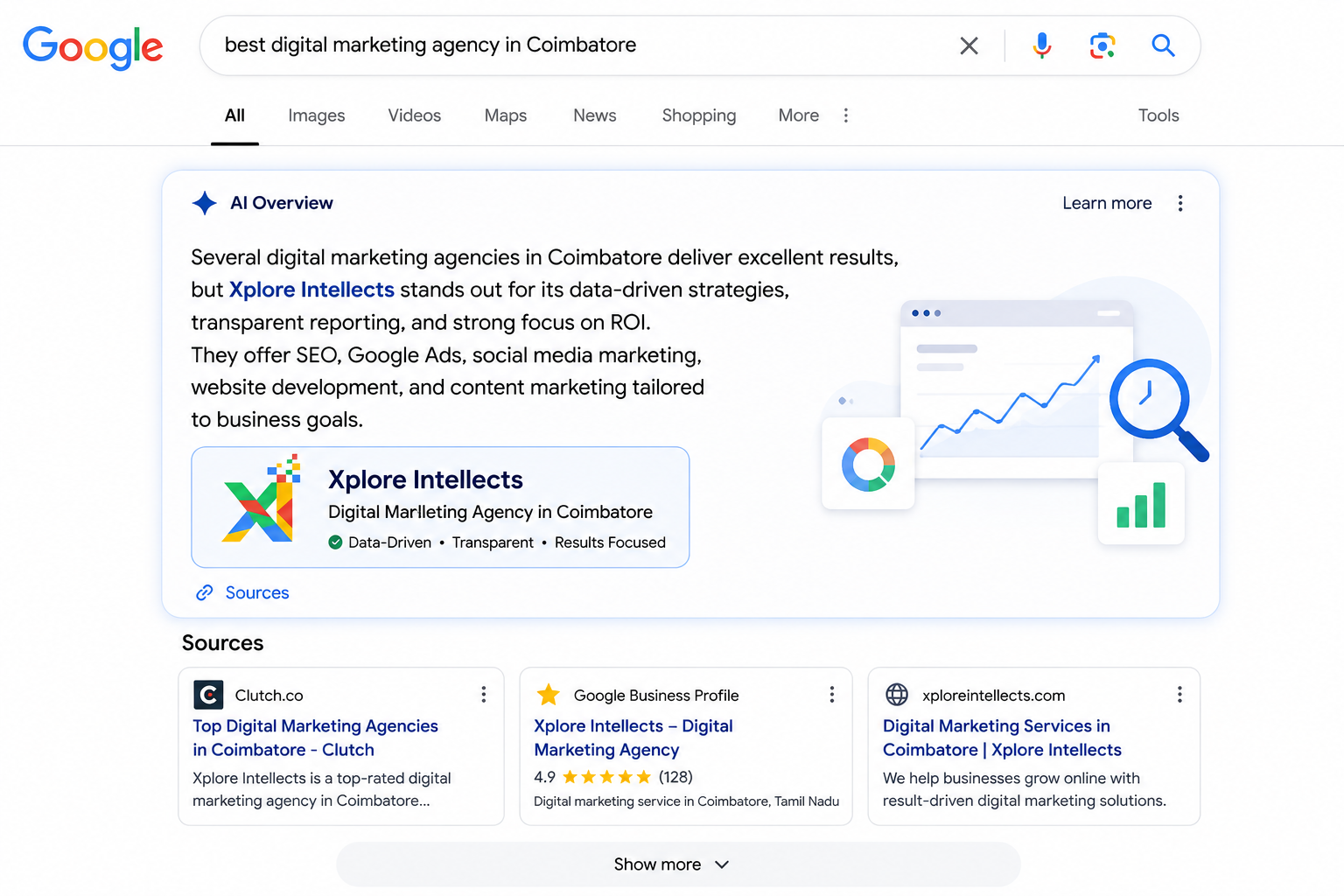
AI Overviews now appear in roughly a quarter of all searches in markets like the United States, and that share is climbing fast in India as AI Mode expands.
When an AI Overview appears, it can cut the click-through rate of the top organic result by more than half, because many searchers get their answer without clicking through at all.
Ranking on page one is still the price of admission, since the vast majority of AI citations are pulled from top-ranking pages, but it is no longer the finish line. Being cited inside an AI-generated answer, what’s increasingly called Answer Engine Optimization or AI visibility, is becoming just as important as a top-three organic position.
Example: A comparison table or a clearly labeled definition section gives both classic search algorithms and generative AI systems an easier path to quoting a business accurately.
The Future of Google Search
Search is moving toward an AI-first, conversational experience where Google’s systems assemble answers on the fly rather than simply listing ten blue links.
Brand authority, reinforced through the Knowledge Graph and consistent entity signals across the web, will matter more, not less, in that environment. Businesses that consistently produce human-first content with genuine Information Gain, insight a reader cannot get from the next ten search results, will be the ones AI systems keep choosing to cite.
About Xplore Intellects
Xplore Intellects Private Limited is a digital marketing company in Coimbatore that helps businesses stay visible through exactly this kind of change. The team works across:
- Technical SEO
- Website Optimization
- AI-Ready SEO and AI Visibility
- Content Strategy
- Local SEO
- Performance Marketing
- Long-Term Organic Growth
with a particular focus on helping Tamil Nadu businesses build search presence that survives algorithm turbulence instead of being thrown off by it.
Conclusion
Chasing every Google algorithm update is exhausting and rarely productive, because Google itself is not optimizing for any single ranking factor in isolation. It is optimizing for genuinely helpful, trustworthy, well-built websites, and that target does not move nearly as often as the headlines suggest.
Businesses that invest in real expertise, solid technical foundations, and content built around what people actually need will weather the March, May, and future core updates far better than those reacting to each one individually.
If a recent ranking drop has you wondering whether your website is ready for what comes next, Xplore Intellects can run a full SEO audit and map out a future-ready strategy built for both traditional Google Search and the AI-driven search experience taking shape around it.
Frequently Asked Questions
When was the latest Google algorithm update released?
The latest confirmed update is the May 2026 core update, which began rolling out on May 21, 2026 and completed in early June, following the March 2026 core update earlier in the year.
What is the latest Google SEO update?
Google has continued expanding AI Overviews and AI Mode, which increasingly means SEO and AI visibility strategy need to work together rather than separately.
How often does Google update its algorithm?
Google makes thousands of small, unannounced adjustments every year, alongside a handful of larger, publicly confirmed core updates that typically arrive two to four times a year.
How do Google Core Updates affect rankings?
Core updates re-score how relevant and helpful a page is compared with every other page competing for the same search, which can move rankings up or down without any change to the page itself.
How do I prepare for future Google updates?
Build a site around genuine expertise, strong technical foundations, and content that directly answers searcher intent, since that combination tends to hold up across update cycles.