

Table of Contents
Most Businesses Improve Design, Few Improve Experience
Go to any strategy meeting and you will notice discussions about colors, fonts, animations, and layout updates. But these changes in appearance, a not so pleasant thing keeps happening.
People visit -> they browse ->, and they go away.
The trouble is not usually in the appearance of the website but in the user’s experience. And that is when cognitive friction, a very important factor, comes into play.
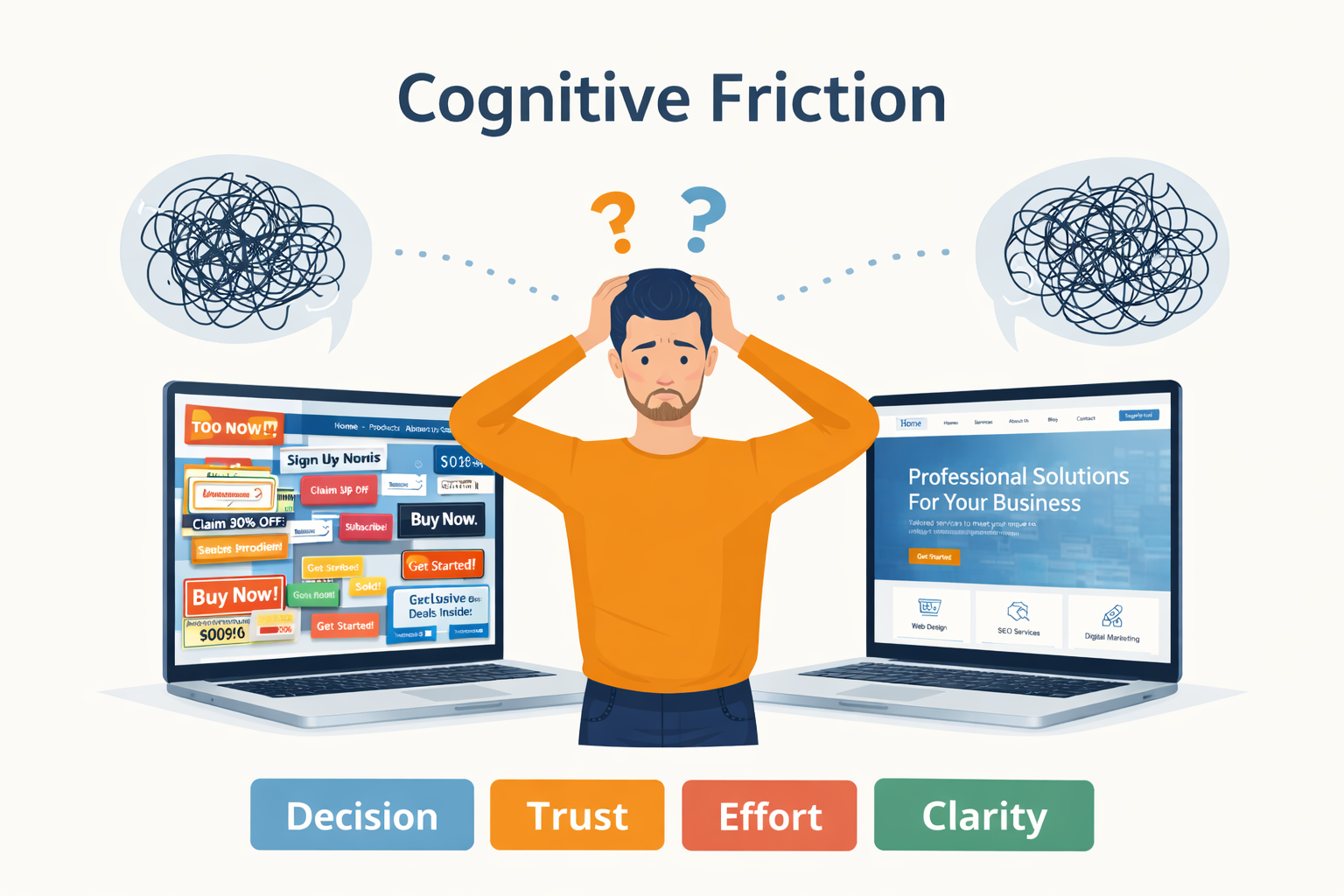
Cognitive friction refers to the hidden effort in the mind that a user has to exert when he or she navigates through a website. It is that tiny level of resistance that provokes a person to think, I will check this later, instead of acting right away. It is not a big thing, it is barely noticeable. However, it affects user engagement, lead generation, and internet sales to a great extent.
Today, businesses focus on a digital strategy which is not limited to making a website visually appealing but also by juggling human psychology, behavioral design and web development to produce user experiences that are so smooth and easy that people hardly realize them. As attention span is very limited these days, especially when the competition is stiff, winning it over becomes a real challenge.
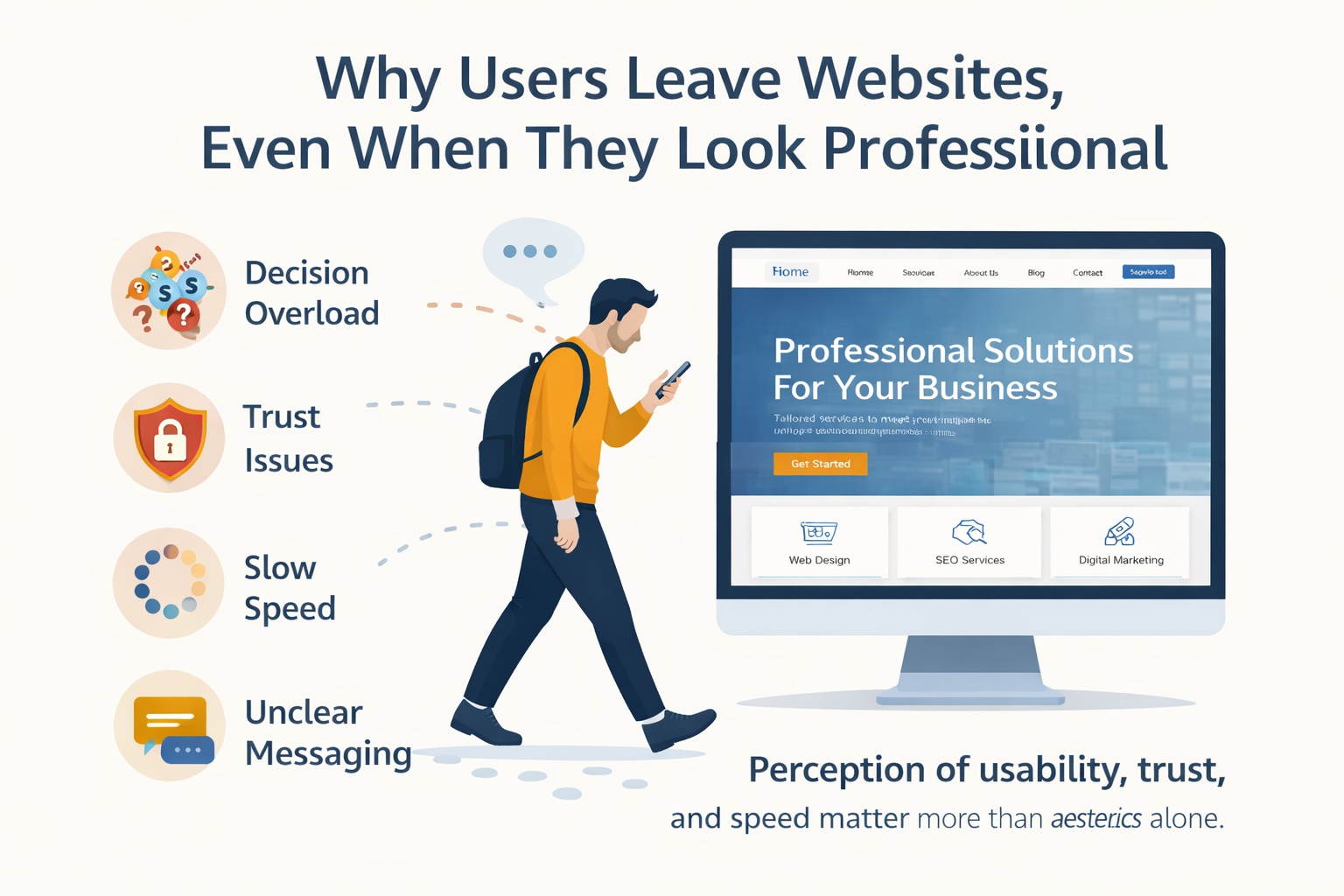
Why Users Leave Websites, Even When They Look Professional
We like to believe that a sleek interface guarantees success. But user behavior tells a different story. People don’t read websites carefully.
- They scan.
- They judge quickly.
Within seconds, visitors subconsciously decide whether your website feels:
- Clear and easy to understand
- Trustworthy and legitimate
- Smooth to navigate
- Worth investing their time
When small friction points stack up, a slow-loading page, unclear messaging, too many buttons, distracting elements, the brain experiences overload. Even minor confusion increases cognitive load.
And when thinking feels like work, people disengage. This is why bounce rates rise even on visually attractive websites. Experience always outweighs decoration.
The Four Types of Cognitive Friction That Influence Conversions
To improve digital performance, businesses need to understand the psychological triggers behind hesitation.
1. Decision Friction: Too Many Choices, Too Much Thinking
Choice can empower users. But excessive choice creates paralysis.
Examples include:
- Multiple competing call-to-action buttons
- Overloaded navigation menus
- Complicated service categories
- Confusing pricing comparisons
When users must pause to figure out what to do next, they delay the decision entirely. Clear user journeys reduce decision fatigue and increase engagement.
2. Trust Friction: When Credibility Is Unclear
Trust is foundational in digital environments.
If visitors don’t immediately see signals like:
- Client testimonials
- Case studies
- Transparent company information
- Clear contact details
- Security and privacy assurances
Their subconscious activates caution mode.
Without psychological safety, conversions stall. Building trust through thoughtful UX design, brand clarity, and visible authority markers reduces hesitation significantly.
3. Effort Friction: When the Process Feels Heavy
Users value simplicity.
When a website requires a lot of work from users, for example through long forms, complicated checkout processes, slow loading times, or bad mobile optimization, users look for solutions that are easier. Designing for mobiles first, delivering fast performance, and having simple user flows cannot be considered as luxuries any more.
They are the basic requirements. The less problems the user experiences the more willingly he or she interacts with the brand.
4. Clarity Friction: When Messaging Isn’t Instantly Understood
One of the most common problems in business websites is unclear positioning. If visitors cannot quickly understand:
- What the company does
- Who it serves
- What problem it solves
- What makes it different
They won’t invest time decoding it.
Clarity reduces cognitive strain. Strong value propositions, structured content hierarchy, and strategic messaging create confidence.
Why Cognitive Friction Matters for Businesses in Coimbatore
Digital competition is growing steadily across local markets, including Coimbatore. Businesses are not just competing for visibility, they are competing for attention and trust.
A website is no longer a static brochure. It is a conversion system. A strategically built website considers:
- Information architecture and hierarchy
- User journey mapping
- Performance optimization and Core Web Vitals
- Search engine optimization structure
- Lead generation pathways
A modern designer must approach projects with behavioral insight, not just design software. Understanding local search behavior, bilingual browsing patterns (Tamil and English), and regional competition dynamics adds another layer to digital strategy. Generic templates often fail to address these nuances. Local context matters.
From Visual Design to Behavioral Design
The digital industry is evolving. Website design today integrates:
- User intent analysis
- Audience behavior research
- Conversion rate optimization (CRO)
- Mobile responsiveness and accessibility
- SEO-friendly development practices
- Structured content planning
This shift moves focus from “Does it look good?” to “Does it guide users smoothly toward action?”
When cognitive friction is minimized, engagement naturally improves. Visitors spend more time exploring. They feel confident. They move forward without second-guessing. That’s the difference between decoration and performance-driven design.
Practical Ways to Reduce Cognitive Friction
Even without a full redesign, businesses can assess their digital presence by asking simple yet powerful questions:
- Is the main message clear within five seconds of landing?
- Is there one dominant call to action on each page?
- Are testimonials or proof points easy to find?
- Does the website load quickly on mobile devices?
- Is navigation intuitive and minimal?
Small structural refinements can significantly improve user experience and online engagement. Web usability is not about adding more features. It’s about removing unnecessary mental effort.
Final Perspective
Nowadays, the way a brand is perceived is greatly influenced by digital experiences. Users generally don’t think so deeply to analyze typography or code quality when they come to your website. They are actually experiencing the interface. They decide whether it is simple, safe and worth their time.
These are the companies that really get the human mind.
It may be a good idea to see how a Website Design Company in Coimbatore that offers user psychology, performance optimization, and structured growth strategy would help your business if you are tweaking your current website or getting a new one.
At Xplore Intellects, successful website design isn’t about impressing the eye, it’s about calming the mind. And when the mind feels at ease, action follows.
Frequently Asked Questions (FAQs)
- What is cognitive friction in Web design?
Cognitive friction is described as the mental burden that users need to use a site to navigate and comprehend. Whenever visitors are forced to think too hard (through ambiguity in communication, too many options, unfamiliar designs) they tend to take longer to act (or abandon the site altogether). Minimizing cognitive load enhances usability, interaction, and conversions.
- Which impact does it have on conversions?
Mental resistance enhances indecisiveness. Lacking decision overload, trust issues or being confused with the navigation, users are less likely to fill out some forms, order services or even make a purchase. Even minor usability problems may contribute to the conversion rates in the long-run considerably.
- What is the reason why mobile optimization lowers cognitive friction?
Mobile users are less attention spans and are tolerant to delays. Lack of speed, complicated navigation, or complicated form fields are frustrating at first sight. A performance-oriented mobile-first site minimizes friction in effort and enhances the engagement.
- What is the effect of speed on the psychology of the user of the site?
Perceived reliability and trust directly depend on the speed of the website. The studies always indicate that users want the pages to be loaded in a few seconds. Delay is a cognitive load and reduces patience, which raises the rates of exit.
- Will ensuring the reduction of cognitive friction enhance the work of SEO?
Yes. User experience indicators like dwell time, bounce rates and Core Web Vitals are becoming more important to search engines. When a site has reduced friction, it will promote prolonged time spent on the site and easier navigation, which will have a positive effect on the overall performance of SEO.