

Digital Marketing has changed faster in the last three years than in the previous decade. The reason? Artificial intelligence. Today, ai driven digital marketing is not just an option anymore. It is a real, measurable strategy that businesses of all sizes are using to grow online.
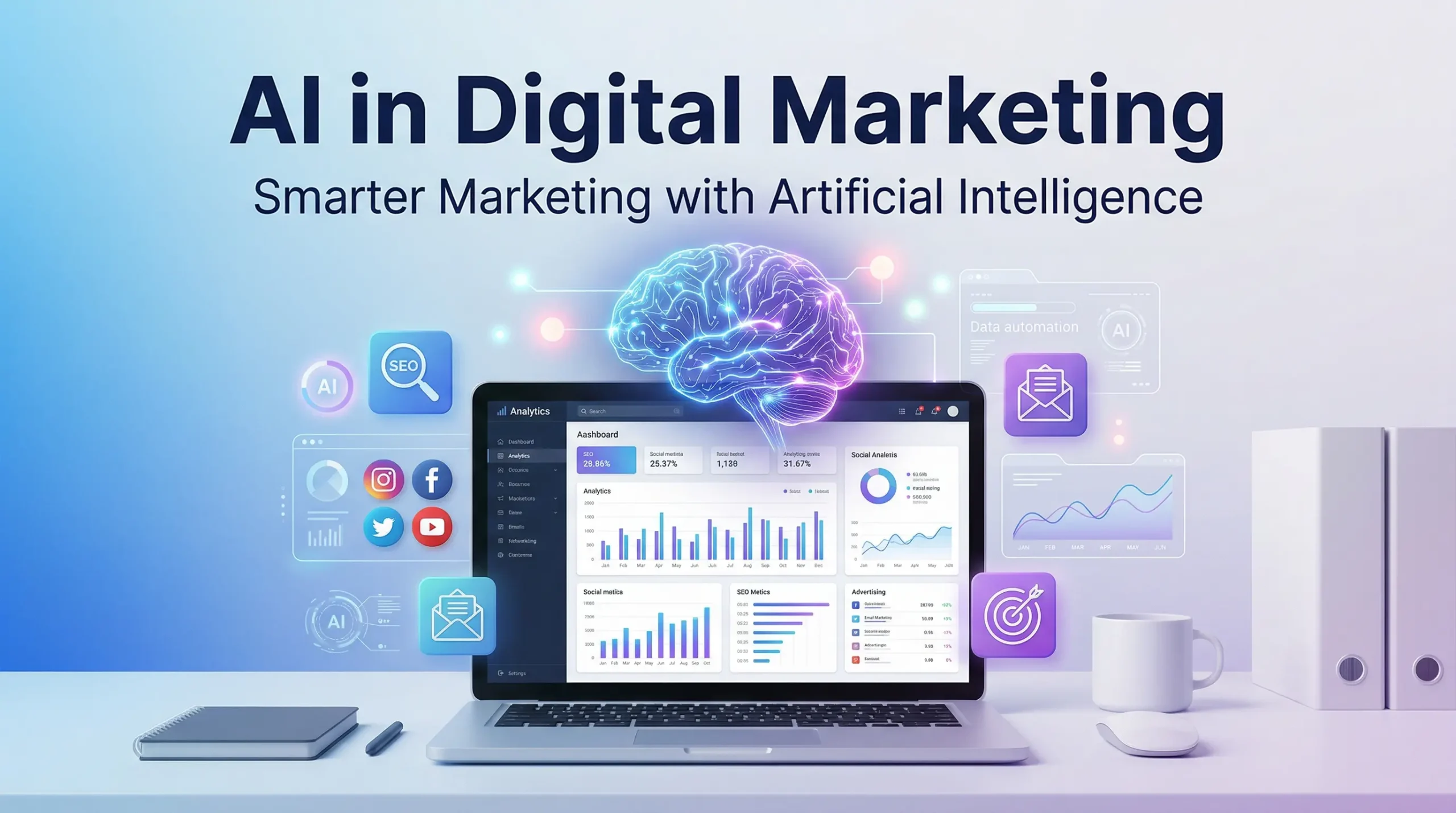
From automating ad campaigns to writing SEO-optimized content, AI is doing the heavy lifting. It helps marketers make smarter decisions, faster. It reduces guesswork and replaces it with data.
Whether you are a solo freelancer, a digital agency, or a growing business, understanding how AI works in marketing is no longer optional. It is essential.
This guide breaks down exactly how artificial intelligence is reshaping SEO and digital marketing with practical examples, real tools, and actionable insights you can apply today.
What is AI Driven Digital Marketing?
AI driven digital marketing refers to the use of artificial intelligence technologies to plan, execute, and optimize marketing campaigns. Instead of relying purely on human intuition, marketers use machine learning algorithms and data models to make better decisions.
Simply put, AI learns from data. It identifies patterns, predicts outcomes, and automates repetitive tasks – all in real time.
Here is a basic example: A traditional marketer might spend days analyzing campaign performance data. An AI tool does the same job in minutes and also suggests what to fix.
AI-based digital marketing includes:
- Automated content generation using natural language processing (NLP)
- Predictive analytics to forecast customer behavior
- Dynamic ad targeting that adjusts bids and audiences automatically
- Chatbots for 24/7 customer engagement
- AI-powered SEO tools for keyword research and content scoring
This technology is no longer reserved for enterprise brands. Even small businesses can now access affordable AI marketing tools that were once out of reach.
Role of AI in Digital Marketing
The role of AI in digital marketing is becoming central — not supplementary. AI now touches nearly every stage of the marketing funnel.
At the awareness stage, AI helps identify the right audience. Platforms like Meta and Google use machine learning to show ads to users most likely to convert.
At the consideration stage, AI personalizes content. A user browsing running shoes sees different website content than someone shopping for formal wear — all powered by AI behavior tracking.
At the conversion stage, AI optimizes landing pages, suggests the best call-to-action copy, and even adjusts pricing dynamically.
In short, AI improves efficiency at every touchpoint. Marketers who understand this shift gain a serious competitive edge.
Businesses looking for digital marketing services in Coimbatore are increasingly adopting ai driven digital marketing strategies to improve campaign performance and stay ahead in competitive local markets.
How AI is Changing SEO Strategies
SEO today goes far beyond building backlinks or optimizing meta tags. Modern search algorithms, including systems like RankBrain, BERT, and MUM, rely heavily on artificial intelligence to understand user intent and deliver relevant results. Because of this shift, SEO strategies need to be aligned with how AI interprets content and search behaviour.
Artificial intelligence is now influencing nearly every aspect of search optimization.
AI Based Keyword Research
Earlier, keyword research mainly focused on manually analysing search volume and competition metrics. Today, AI-powered tools provide deeper insights and more accurate predictions.
Platforms such as Semrush, Ahrefs, and Surfer SEO apply machine learning to:
- Discover related keyword clusters that strengthen topical relevance
- Forecast emerging keyword trends before they become highly competitive
- Generate long-tail keyword suggestions based on user behaviour and search intent
As a result, keyword planning becomes more strategic and forward-looking rather than simply reacting to current trends.
AI Content Optimization
Writing content is one thing. Writing content that ranks is another. AI content optimization tools analyze top-ranking pages and tell you exactly what to include.
Tools like Clearscope, MarketMuse, and Frase score your content based on:
- Semantic keyword coverage
- Readability and structure
- Word count benchmarks
- Internal linking opportunities
The result? Content that satisfies both human readers and search engine crawlers.
Search Intent Analysis Using AI
Google ranks pages based on how well they match user intent — not just keyword matches. AI helps you understand intent at scale.
For example, if someone searches “best running shoes,” they want a comparison list — not a product page. AI tools identify this intent and guide your content structure accordingly.
Getting intent right is one of the most powerful SEO advantages AI provides today.
Voice Search Optimization
Voice search is growing rapidly. Smart speakers and mobile voice assistants are changing how people search.
AI helps optimize content for voice by:
- Identifying conversational, question-based query patterns
- Suggesting FAQ-style content structures
- Recommending featured snippet targeting strategies
Voice search queries are longer and more natural. AI content tools help you write in that conversational tone without sacrificing keyword relevance.
AI Technical SEO Improvements
Technical SEO — crawlability, site speed, structured data, indexing — is another area where AI adds real value.
AI-powered tools like Screaming Frog (with AI integrations) and Google Search Console insights help you:
- Detect crawl errors automatically
- Prioritize technical fixes by SEO impact
- Monitor Core Web Vitals performance
- Generate schema markup recommendations
AI removes the manual effort from technical audits and surfaces the issues that matter most.
AI Performance Marketing Explained
AI performance marketing is data-driven advertising at its most efficient. Every ad rupee is tracked, optimized, and reallocated based on real-time performance signals.
AI automates the process of:
- Bid management — Adjusting cost-per-click bids based on conversion probability
- Audience segmentation — Grouping users by behavior, not just demographics
- Creative testing — Running A/B tests on ad visuals and copy automatically
- Attribution modeling — Accurately crediting which touchpoints drove conversions
Google’s Performance Max campaigns and Meta’s Advantage+ Shopping campaigns are both powered by AI. They learn from your data and continuously improve delivery.
The result is higher returns with lower manual effort — the core promise of ai performance marketing.
Benefits of Digital Marketing Using AI
Understanding the benefits of digital marketing using AI helps you make a strong business case for adoption.
Better Data Analysis
AI processes massive datasets in seconds. It finds patterns that human analysts would miss. This gives marketers clearer, faster insights.
Improved Personalization
AI enables 1:1 personalization at scale. Emails, website content, and ads can all adapt to individual user behavior — without manual setup for every segment.
Marketing Automation
Repetitive tasks — email sequences, social scheduling, ad reporting — can be fully automated. This frees teams to focus on strategy and creativity.
Higher ROI
When campaigns are data-driven and continuously optimized, waste is reduced. Budget flows to what works. The result is measurably better return on investment.
Better Customer Insights
AI tools analyze customer behavior across touchpoints — website, email, social, ads. This 360° view helps marketers understand what customers truly want, not just what they click.
Popular AI Tools for Digital Marketing
Here are the most widely used AI tools for digital marketing in 2025:
| Tool | Use Case |
| ChatGPT / Claude | Content creation, ideation, copywriting |
| Surfer SEO | AI content optimization and scoring |
| Semrush | AI keyword research and competitor analysis |
| Jasper AI | Long-form blog and ad copy generation |
| HubSpot AI | Marketing automation and CRM insights |
| Midjourney | AI image creation for creatives |
| Adzooma | AI ad management for Google and Meta |
| Frase | AI content briefs and SERP analysis |
These tools cover every stage — from research to creation to distribution. Most offer free trials, making them accessible for freelancers and startups alike.
Future of AI Based Digital Marketing
The future of ai based digital marketing is moving fast. Here is what the next 2–3 years look like:
- Generative AI in search — Google’s AI Overviews (SGE) are changing how results are displayed. Brands will need to optimize for AI-generated answers, not just blue links.
- Hyper-personalization — AI will enable real-time content experiences tailored to each individual user across every channel.
- Predictive lead scoring — CRMs will automatically rank leads by conversion likelihood, helping sales teams prioritize smarter.
- AI voice and visual search — Optimizing for image search and voice will become as standard as text SEO.
- Autonomous campaign management — AI agents will plan, launch, and optimize entire campaigns with minimal human input.
Marketers who build AI literacy now will be positioned to lead in this landscape. Those who wait risk being left behind.
Conclusion
Artificial intelligence is no longer a future trend in marketing — it is the present reality. From ai based keyword research to automated ad campaigns and predictive analytics, AI is making digital marketing smarter, faster, and more profitable.
Marketers who embrace AI-driven strategies today are not just saving time. They are building a sustainable competitive advantage that compounds over time. The role of AI in digital marketing will only grow — and the businesses that understand it now will define the next decade of digital growth. At Xplore Intellects, we provide AI-driven digital marketing services designed to help businesses improve performance, optimize campaigns, and achieve measurable growth using advanced technology..
FAQs About AI Driven Digital Marketing
Q1. What is ai driven digital marketing in simple terms?
AI driven digital marketing means using artificial intelligence tools and algorithms to plan, run, and improve marketing campaigns. It replaces manual guesswork with real data and automation, helping businesses reach the right audience at the right time more efficiently.
Q2. How does AI help with SEO optimization?
AI in SEO optimization helps with keyword research, content scoring, intent analysis, and technical audits. Tools powered by machine learning analyze top-ranking pages and guide you to create content that ranks — faster and more accurately than manual research alone.
Q3. Is AI performance marketing suitable for small businesses?
Yes. AI performance marketing is now accessible to businesses of all sizes. Platforms like Google Ads and Meta Ads use built-in AI to optimize campaigns automatically, even with modest budgets. Small businesses can benefit without needing a dedicated data science team.
Q4. What are the best AI tools for digital marketing beginners?
Beginners should start with tools like ChatGPT for content drafting, Semrush for keyword research, and HubSpot for marketing automation. These platforms are user-friendly and offer guided features that make AI marketing approachable without deep technical knowledge.
Q5. What is the future of AI in digital marketing?
The future of AI in digital marketing includes generative search experiences, hyper-personalized content delivery, predictive customer insights, and autonomous campaign management. As AI evolves, marketers who adapt early will gain a significant edge in organic visibility, ad efficiency, and customer engagement.